Produtos similares
Características de Desempenho da Furadeira de Ar Descrição dos Parâmetros da Furadeira de Ar Fornecimento Direto do Fabricante Produção Furadeira de Ar
Quantidade
Correspondências exatas por um preço menor




Produtos similares a um preço mais baixo







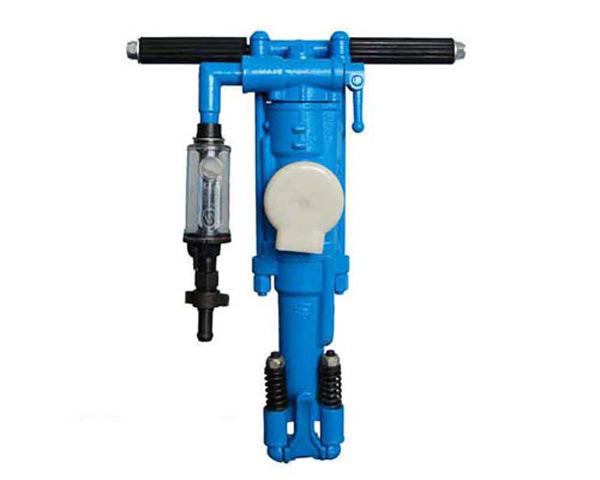

Air Drill Product Introduction
A pneumatic drill is a drilling tool powered by compressed air, and is mostly used for drilling holes in construction sites, concrete, rocks, etc.
Pneumatic Drilling Principle
The pneumatic drill works on the principle of impact crushing. During operation, the piston performs high-frequency reciprocating motion, continuously impacting the drill tail. Under the action of the impact force, the sharp wedge-shaped drill head crushes the rock and drills into a certain depth, forming a dent. After the piston retreats, the drill bit turns a certain angle, and the piston moves forward. When it impacts the drill tail again, a new dent is formed. The fan-shaped rock between the two dents is sheared by the horizontal force generated by the drill head. The piston continuously impacts the drill tail, and compressed air is continuously input from the center hole of the drill bit to discharge the rock slag out of the hole, that is, a circular drill hole of a certain depth is formed. It is suitable for construction sites without power and air sources.
Pneumatic drill operating procedures
1. Precautions before work:
⑴ Prepare drill pipes, drill bits, engine oil and other tools required by this shift.
⑵ Check whether all parts of the pneumatic drill are intact (including water needle, piston, screw rod, switch, etc.), inject appropriate amount of oil into the oil reservoir, tighten the cap, and ensure that the oil is clean.
⑶ Check whether the air and water pipes are smooth, and blow out the water and debris in the hoses.
⑷ Turn on the switch gradually and check the wind and water pressure conditions.
⑸ Check the length of the drill tail, etc. If it is unqualified, it is prohibited to use it.
2. Turn on the water first and then the wind. Only after the drill bit penetrates into the rock formation can the eye-dotting personnel leave. Then turn on all the switches of the pneumatic drill. During the drilling process, ventilation should be frequently used to discharge powder to prevent excessive force on the drill and broken rods causing injuries. Refueling should be done at any time according to the model and performance requirements of the pneumatic drill. Do not knock or throw the pneumatic drill. Throw it away to prevent damage to pneumatic drill parts.
3. When rotating the pneumatic drill, master the direction and angle of the pneumatic drill, and at the same time ensure that the drill pipe, eye opening, and pneumatic drill are in a straight line. Pay attention to safety when moving the drill frame.
4. You are not allowed to wear gloves when drilling holes. The towel must be tightly wrapped and both ends must not be exposed. Tie the cuffs of your raincoat tightly to avoid getting entangled in the rotation of the pneumatic drill, and check the air duct joints frequently to prevent the air duct from falling off and injuring anyone.
5. When driving anchor bolts or performing suspended operations, a workbench must be set up to prevent broken bolts from injuring people.
6. When the pneumatic drill is not easy to use, it should be replaced and repaired in time. After drilling, the pneumatic drill should be well oiled, and the pneumatic drill, together with the air and water hoses, should be placed in a safe place to avoid damage by blasting or intrusion of gangue and sewage into the drill.